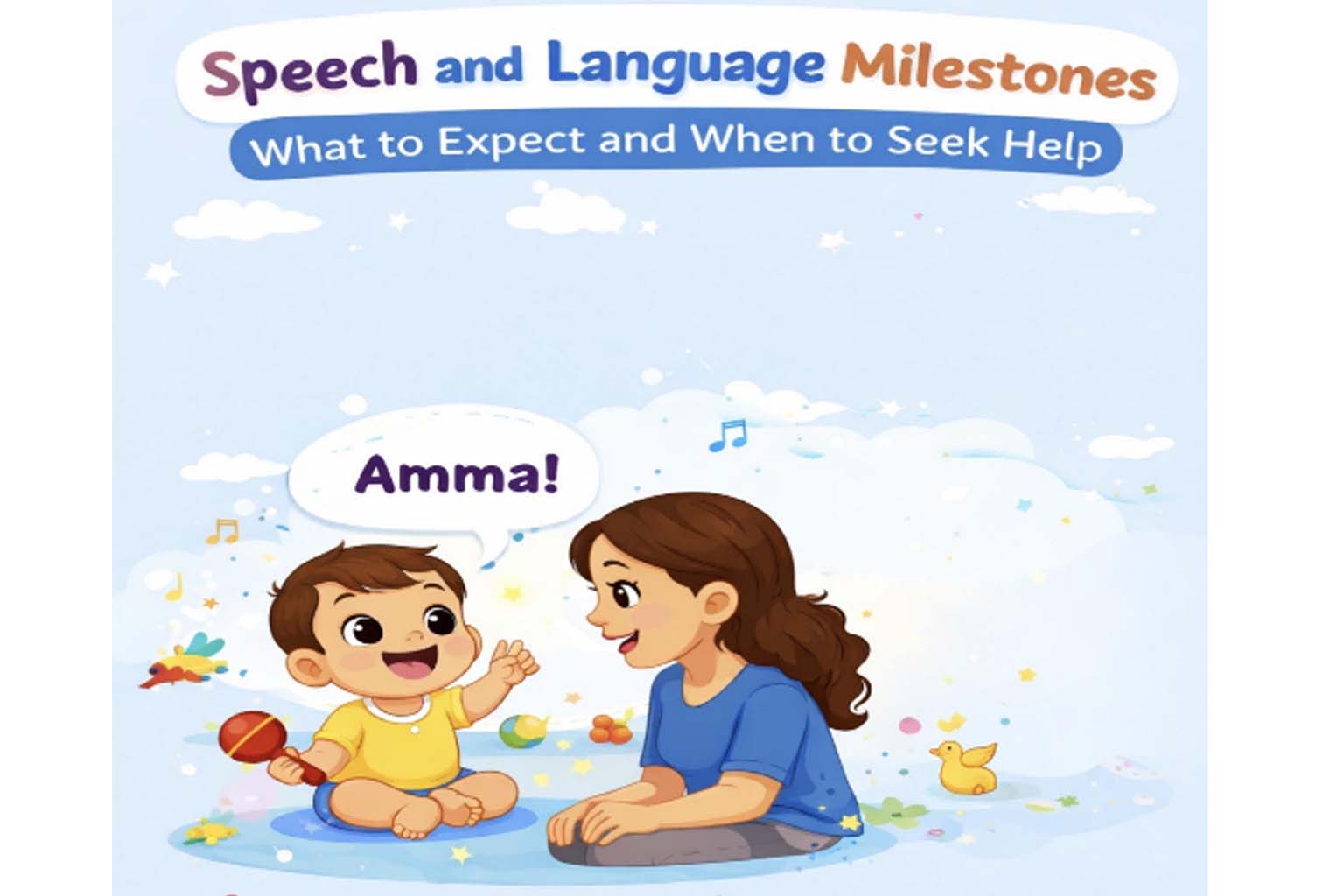

Speech and Language Milestones: What to Expect and When to Seek Speech Therapy
This resource is designed to help parents and caregivers easily understand speech and language developmental milestones. It explains what children are expected to achieve at different ages, including the typical ages at which specific speech sounds emerge. This information supports early identification of possible speech or language delays and helps parents and caregivers recognize when a child may benefit from speech and language therapy.
“Every child learns to communicate at their own pace. Some children start talking early, while others take a little more time”. This natural variation is normal. However, understanding speech and language milestones helps parents and caregivers know what is typical for a child’s age and when extra support may be needed.
Early identification of speech or language difficulties can make a significant difference in a child’s communication.
What Are Speech and Language Milestones?
Speech and language milestones are skills that most children develop by certain age ranges as they grow. These milestones act as general guidelines not strict rules helping parents and professionals track a child’s communication development.
Speech vs Language: What’s the Difference?
Many parents use the terms speech and language interchangeably, but they are not the same.
Speech
Language
A child may have difficulty with speech, language, or both.
Common Myths About Speech and Language Development
The truth:
Research shows that these beliefs often delay help. Bilingual children can learn multiple languages successfully, and waiting too long can make intervention harder later.
Language Milestone:
The language development of children will first be reviewed age by age, highlighting the expected milestones from birth up to five years of age.
Birth – 6 Months
6 – 12 Months
12 to 18 months
18 to 24 months
2 – 3 years
3 – 4 years
4-5 years
In a very simple way, language development can be understood by matching a child’s age with expected speech output. For example, by one year of age, a child is expected to say at least one meaningful word; by two years, two-word combinations should emerge; and by three years, the child should be able to speak in short phrases (3words). This age-based approach helps parents and caregivers easily identify whether a child may be experiencing a language delay.
Speech Milestones:
The next section explains the ages at which children typically begin to produce different speech sounds, helping parents and caregivers understand whether sound development is age appropriate.
Speech sound development refers to a child’s ability to produce sounds accurately without substituting them with other sounds. These sounds are acquired gradually at different ages as the child’s speech mechanism matures.
Speech sounds can be broadly classified into voiced and voiceless sounds. Voiced sounds are produced using vibration of the vocal folds (voice box), such as /d/, /g/, and /b/. Voiceless sounds are produced without vocal fold vibration, such as /p/, /t/, and /k/.
Speech sounds are also described based on their place of articulation, which refers to where the sound is produced in the mouth. For example, bilabial sounds like /p/, /b/, and /m/ are produced using both lips; alveolar sounds such as /t/, /d/, and /s/ are produced with the tongue touching the ridge behind the upper teeth; and velar sounds like /k/ and /g/ are produced at the back of the mouth with the tongue touching the soft palate. Understanding these differences helps in identifying whether a child’s speech sound development is age appropriate.
Children learn speech sounds based on the language and environment they grow up in. In India, children from different regions, such as North India and South India, may learn certain sounds earlier or later because the languages spoken around them are different. Some sounds are commonly used in certain languages, while others are used less often. Because of this, a few children may learn all speech sounds early, while others may take more time to learn specific sounds. Sounds like /r/ and /l/ can be difficult for some children, as they require precise tongue placement and movement, which may vary depending on the language spoken at home and in the community. Research conducted in India shows that speech sound development is influenced by regional language exposure, and such variations are considered part of typical development within that linguistic context. Kaur, R., & Subbarao, T. A. (2017); George, J. (2021); Roy, R., & Sreedevi, N. (2024)
What Is Speech Therapy?
Speech therapy is a structured, play-based intervention provided by a trained Speech-Language Pathologist (SLP). It focuses on helping children:
Therapy is child-friendly, engaging, and tailored to each child’s needs.
When Should You Seek Speech Therapy?
You should consider consulting a speech-language professional if:
There are no fixed rules or strict requirements such as a specific age or sitting tolerance for starting speech and language therapy.
Speech therapy does not depend on a child’s ability to sit for long periods or follow structured tasks. When a delay in speech or language is noticed, early intervention is highly recommended. Early evaluation does not label a child it supports them.
Starting speech therapy as early as possible helps support communication development during the most critical learning years. Early therapy focuses on play-based, child-centered activities that match the child’s developmental level and attention span. Seeking professional guidance at the earliest sign of concern can make a significant difference in improving speech and language outcomes. Anuj Srivastava (2025); Kakhramonova Zebuniso Raufjon kizi (2025)
How Parents and Caregivers Can Support Language at Home:
Parents play a powerful role in language development. Simple daily interactions make a big difference:
Consistency matters more than perfection.
A Gentle Reminder to Parents:
Every child deserves the chance to communicate, connect, and express themselves. If you have concerns, trusting your instincts and seeking guidance early can positively shape your child’s future.
References:
1. Sreeja, T. D. (2018). Pre-linguistic development in infants: Perception and production (Doctoral research work).
2. Feldman, H. M. (2019). How young children learn language and speech. Pediatrics, 143(4), e20182309.
3. American Speech-Language-Hearing Association (ASHA)
4. Kakhramonova Zebuniso Raufjon kizi (2025) – The Role of Early Intervention in Speech and Language Disorders
5. Anuj Srivastava (2025) – Early Intervention Techniques for Toddlers with Language Delays
6. Alexa V. Lutfy (2025) – The Importance of Early Intervention for Speech, Language, and Hearing Development
Dr. Rahul Indrajith
Speech Language Pathologist (MSc Speech Language Pathology)
vijayawada
8866549449
vishakapatnam
9169599699
Hyderabad7702500190
11-02-2026 at 10:25 PM
Child is improvement observed. Still a long way to go . At some aspect it's costlier to bear also. Kindly organisation also work on it