

Get the right care for your child
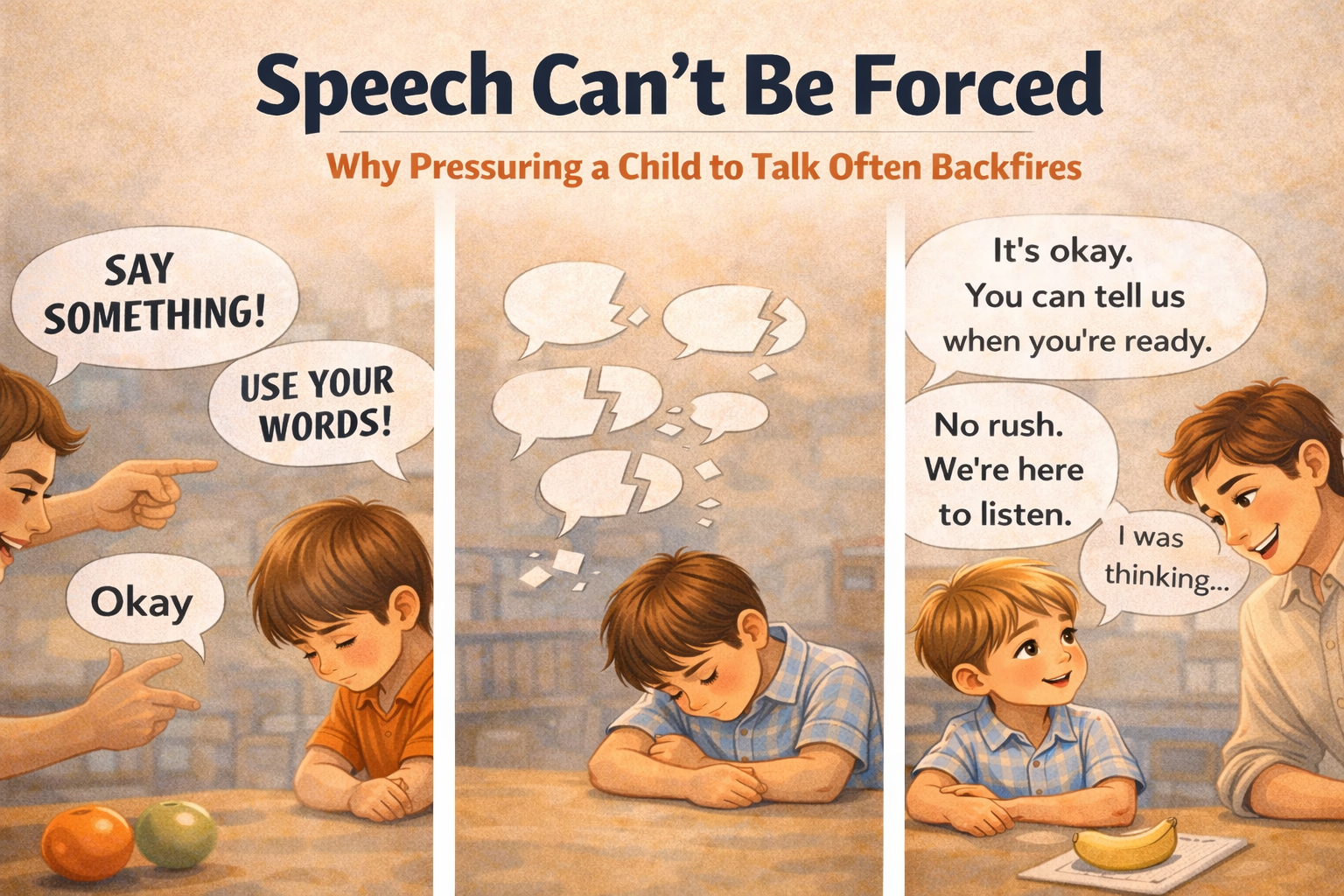
Speech Can’t Be Forced: Why Pressuring a Child to Talk Often Backfires
A Simple and Clear Guide for Parents and Caregivers
When a child is not speaking as expected, it is natural for parents and family members to worry. Many adults try to help by asking the child to repeat words, speak clearly, or answer questions again and again. Although the intention is good, forcing a child to speak often creates more problems instead of helping.
This blog explains in simple language why pressuring a child to talk can backfire, how it affects the child, and what parents can do instead to support healthy speech development.
How Children Learn to Speak
Children do not learn speech by force. Research shows that speech develops best when many things come together:
If a child feels scared, rushed, or judged, their brain focuses on stress instead of learning. A relaxed child learns better than a pressured child (ASHA, n.d.; Kuhl, 2004).
Why Forcing a Child to Speak Can Be Harmful
1. It Makes the Child Anxious or Fearful
When a child is often told:
“Say it again”
“You know this word”
“Speak properly”
The child may start feeling nervous about talking. Anxiety makes it harder for the brain to think, remember words, and control speech movements (Kuhl, 2004).
Over time, the child may:
2. The Child Starts Avoiding Communication
When speaking feels stressful, silence can feel safer for a child. If they are constantly corrected or pressured to speak, some children may stop trying altogether, avoiding communication to escape frustration or fear of mistakes. This withdrawal reduces opportunities to practice language, limits learning, and can slow overall speech and language development. Creating a supportive, patient environment encourages children to communicate without fear, helping them gradually build confidence and skills
(Paul & Norbury, 2012).
3. It Affects the Child’s Confidence
Repeated correction and pressure can make a child feel:
“I am not good at talking”
“I always do it wrong”
Low confidence can affect how the child interacts with others at home, school, and social settings (ASHA, n.d.).
4. It Ignores Other Important Ways Children Communicate
Before children speak clearly, they communicate using:
These are important steps toward speech and language development (Bruner, 1983; Paul & Norbury, 2012). Forcing only spoken words can stop these natural communication skills from growing.
5. It Can Lead to Long-Term Problems
In some children, constant pressure to speak may lead to the following difficulties, especially in emotionally sensitive children (Toppelberg & Shapiro, 2000):
This is why a gentle, supportive approach is always better than forcing (Toppelberg & Shapiro, 2000).

What Parents Can Do Instead?
1. Talk With Your Child, Not At Them
Join your child during play and everyday routines, and talk about what they are doing or noticing. Following their lead and describing actions or objects helps children learn language naturally through shared interaction.
2. Show Words, Don’t Demand Them
Instead of saying:
“Say apple.”
Try saying:
“Apple. Red apple. Crunchy apple.”
Model words naturally instead of asking the child to repeat them. Hearing words many times in a relaxed, pressure-free way helps children understand and use language when they are ready.
3. Accept All Communication Attempts
Respond positively when your child.
For example, if a child points to an object or makes a sound, respond by naming the item and expanding on their attempt (e.g., “You want the ball! Big ball!”). This reinforces the child’s intent while providing a clear language model, without pressure to repeat or correct
This shows the child that communication is successful and valued, which supports further language growth (Bruner, 1983; ASHA, n.d.)

4. Create Opportunities, Not Pressure
Language grows best when children are given natural reasons to communicate, rather than being forced to speak. By thoughtfully setting up everyday situations, adults can gently invite communication in a stress-free way.
For example,
Equally important is waiting patiently. Giving the child enough time to process and respond shows respect for their pace and reduces pressure
5. Focus on Connection First
Children learn best when they feel loved, safe, and accepted (Paul & Norbury, 2012; Kuhl, 2004). A strong emotional connection creates the foundation for communication and learning. When a child feels understood and valued, they are more willing to attempt new sounds, words, and interactions without fear of failure.
Instead of focusing only on clear or correct speech, acknowledge and praise the child’s effort, attempts, and intent to communicate. Respond warmly to gestures, vocalizations, and approximations, showing the child that their message matters. This positive reinforcement builds confidence, reduces frustration, and encourages repeated attempts at communication.
By prioritizing connection over correction, caregivers and therapists create a supportive environment where language develops naturally through trust, shared attention, and meaningful interactions.
6. Using AAC (Augmentative and Alternative Communication)
Some children benefit from AAC, which includes tools like picture boards, sign language, or communication apps. AAC is not a replacement for speech, but a bridge that:
Using AAC alongside speech attempts empowers children to express themselves without pressure (ASHA, n.d.).

When to Seek Professional Help
You should consult a Speech-Language Pathologist (SLP) if your child:
Speech therapy supports communication in a positive, pressure-free way and focuses on building confidence and readiness to communicate (ASHA, n.d.).
Take-Home Message
Speech grows with patience, not pressure. Forcing words can create fear, anxiety, and avoidance, while warmth, connection, and natural interaction build confidence and motivation to communicate.
When children feel safe, understood, and encouraged, language develops naturally, and speech emerges at its own pace. By nurturing communication in a pressure-free way, parents create a strong foundation for lifelong communication and confidence.

References
American Speech-Language-Hearing Association (ASHA). (n.d.). Early Language Development.
Kuhl, P. K. (2004). Early language acquisition: Cracking the speech code. Nature Reviews Neuroscience, 5(11), 831–843.
Paul, R., & Norbury, C. (2012). Language Disorders from Infancy Through Adolescence. Elsevier.
Toppelberg, C. O., & Shapiro, T. (2000). Language disorders and anxiety in childhood. Journal of the American Academy of Child & Adolescent Psychiatry.
Dr. Shruti Nair
Speech-Language Pathologist (BASLP)
 vijayawada
8866549449
vijayawada
8866549449 vishakapatnam
9169599699
vishakapatnam
9169599699 Hyderabad7702500190


Comments
No comments yet. Be the first to comment!